
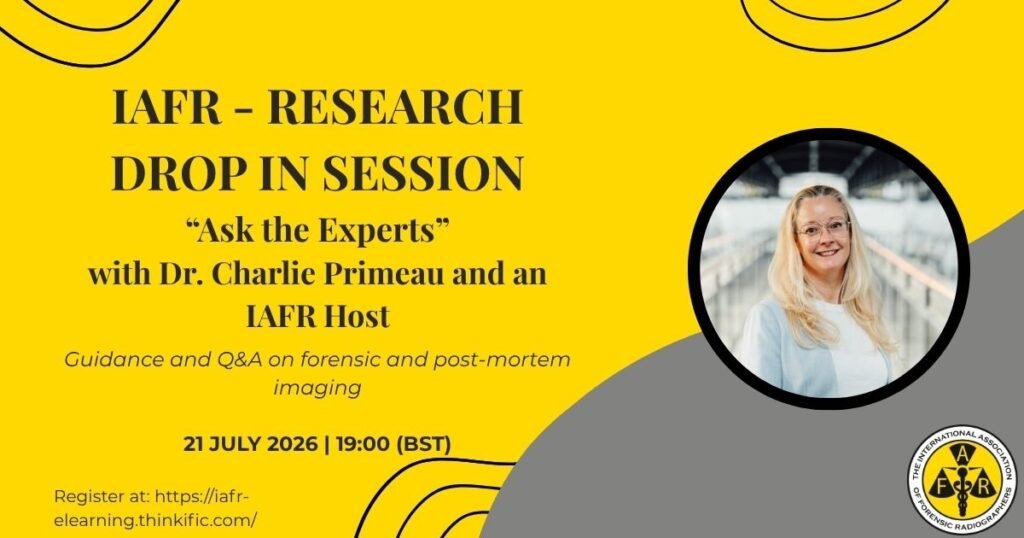
The IAFR recently hosted its first Research Drop-In Session, hosted by IAFR Chair Amy-Lee Brookes and featuring expert speaker Dr. Charlie Primeau, alongside an experienced panel including Dr. Claire Robinson and Dr. Michaela Davis, who are all radiographers with research experience including PhDs. An informal forum for those interested in post-mortem and forensic imaging research, the session provided attendees with the opportunity to ask questions, share experiences and seek advice from researchers with experience in the field. While the panel was clear that they could not act as supervisors for individual projects, they offered valuable guidance on research design, methodology, ethics and publication.
Charlie presented an overview of the current post-mortem imaging research landscape. A key takeaway for anyone considering a research project was to start by understanding what data is realistically available. The best research question in the world can be difficult to answer if the data simply cannot be accessed!
Where to start?
The panel explored a range of research methodologies commonly used within forensic and post-mortem imaging, including:
– Diagnostic accuracy studies
– Validation studies
– Agreement and reliability studies
– Experimental research
– Qualitative studies
– Service evaluations
– Audits and descriptive research
– Systematic reviews
For those new to research, smaller audits or service evaluations were highlighted as excellent starting points. The panel also reminded attendees that replication and validation studies are highly valuable and play a crucial role in strengthening the evidence base.
Ethics and Governance
Ethics was a topic that generated significant discussion throughout the session. Attendees shared experiences of navigating research approvals, particularly when projects involve living subjects or vulnerable populations in forensics. The session also highlighted the differences between countries and the need for local advice to ensure all research meets local ethical and research governance guidance and legislation.
The panel encouraged researchers to engage with local research governance teams and ethical advisors as early as possible during project planning. Claire also discussed examples of pilot studies comparing imaging findings with invasive post-mortem outcomes, demonstrating how smaller projects can generate meaningful evidence and support future research!
Confidence in Research
Discussion also focused on the implementation of post-mortem imaging and how research can support wider understanding of its role within forensic practice. The panel emphasised the importance of collaboration between imaging and pathology professionals and highlighted that studies demonstrating reproducibility, validation and real world outcomes can help strengthen confidence. Trauma imaging was discussed as an area with an already established evidence base, making it a useful starting point for some research projects.
The Panels Top Tips
– A narrow, well-defined research question is often more achievable and impactful than a broad project.
– Research takes time!! Personal interest helps maintain motivation throughout the process.
– Involve clinical experts, researchers, statisticians and other stakeholders early.
– Good planning strengthens the quality of the final study.
– Whether collecting data or using questionnaires, testing your process can help identify issues before they become problems.
Your First Research Paper?
One of the most interesting discussions was on the writing process. The panel revealed that even experienced researchers don’t all approach writing in the same way:
Charlie: “Start with the methodology.”
Michaela: “Begin with the literature review to identify research gaps and shape study design.”
Claire: “Draft the outline of the paper early to help define the story the paper will tell.”
Despite their different approaches, everyone agreed on one thing- there is no perfect way!
There are many resources online to help anyone wanting to start to write a paper or learn about how to, such as the Elsevier Research Academy: https://researcheracademy.elsevier.com/
The Research Gaps
As the session drew to a close, attendees discussed areas where further research is needed. Some key themes emerged:
– Validation studies
– Standardisation of practice
– Staff wellbeing and emotional welfare
– The impact of post-mortem imaging work on radiographers
– Family experiences and support needs
Reflection on the Session
The interactive format generated excellent discussion and allowed attendees to benefit from multiple experts perspectives. Thank you to Charlie, Claire and Michaela for sharing their knowledge and experience, and to everyone who attended and contributed to the conversation!
The success of this first event has highlighted the value of creating spaces where members can discuss ideas, seek advice and connect with others undertaking research in forensic and post-mortem imaging.
Have a research idea?
Future Research Drop-In Sessions will provide opportunities to discuss research questions, share experiences and learn from colleagues across the forensic and post-mortem imaging community. Keep an eye on future IAFR communications and social media for upcoming dates and themes.
PDF version of this report can be found below, this includes papers and resources discussed in the session.